Article 4 of 4
Spirit Animal and Symbol:
The Dragon in Esotericism and the New Age
The first three articles in this series have examined the dragon from a historical, psychological, and artistic point of view: its origins, its spread, and its literary evolution. But to conclude, I would like to explore another dimension in which dragons have gained significant importance in recent years. There is a spiritual-esoteric interpretation of the dragon that focuses less on its history and more on the symbolism it embodies and the significance it can hold in this time of massive change we are currently experiencing.
From Myth to Symbol
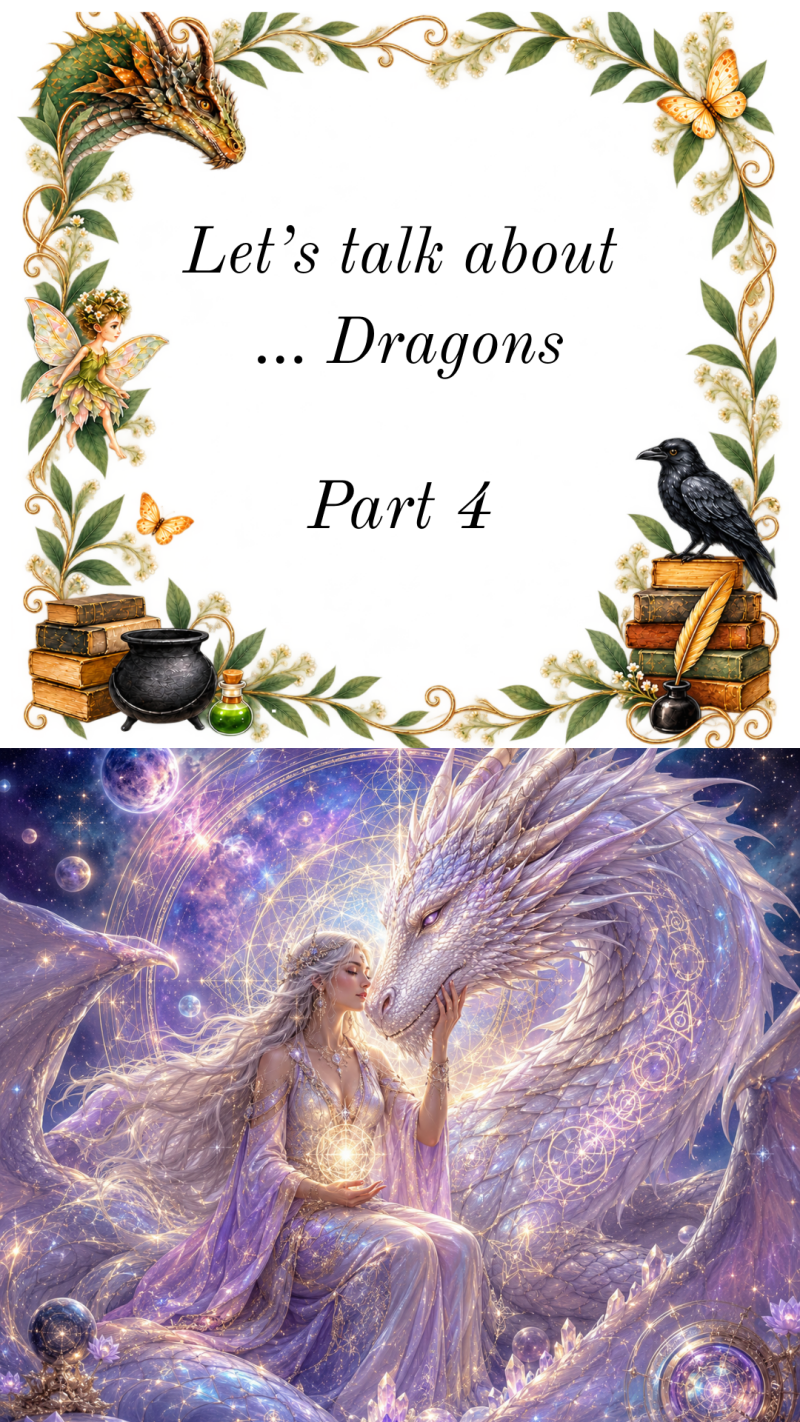
In the context of esotericism and the New Age, the dragon becomes a spiritual symbol: as a spirit animal, as a guardian of knowledge, as a bearer of transformative energy, or as a mediator between the visible and invisible worlds. The crucial difference from everything we’ve discussed in previous articles is that here, the focus is primarily on an inner image that people can work with.
As a spirit animal or spiritual companion, the dragon represents inner strength and protection. As a guardian of hidden knowledge, it ties in with the ancient motif of the treasure keeper, though the treasure is reinterpreted as intangible values like wisdom or self-knowledge. As a symbol of transformation, it stands for upheaval, rebirth, and personal development. Some traditions even speak of a distinct “dragon energy” that one can specifically connect with through meditation or energy work.
Old Images, Reinterpreted
This modern use is not a break with tradition, but rather an additional interpretation. It clearly ties in with older imagery: the Chinese dragon as a symbol of good fortune and power, which we encountered in Article 1, or the European dragon as the guardian of a treasure, which in Article 3 still appeared as a mere obstacle for heroes. The difference lies in the level of interpretation: whereas myths and heroic epics situate the dragon within a mythological or religious context, here it is interpreted psychologically and spiritually—as an anchor for subtle energy work and the development of consciousness, not as an adversary that must be defeated.
Some esoteric movements go a step further and hold the view that dragons were real beings who withdrew from our 3D world to another plane of existence or frequency. As the Earth’s frequency rises, a reconnection is now taking place with those beings whose memory has been preserved in the guarded realm of mythology. In spiritual communities around the world, there are mediums who lead meditations or channel energies from these other planes.
Three Levels, One Theme
To truly capture the topic, it is helpful to distinguish between three levels: first, the historical myth, as we have explored it in the first articles of this series; second, cultural symbolism, as reflected in literature, film, and heraldry; and third, the modern esoteric interpretation, which conceives of the dragon as a higher-dimensional entity. None of the explanations this series has offered—mine or anyone else’s—add up to a single, conclusive answer, because there simply isn’t one. Perhaps that gap is exactly why this third level has grown so prominent today. At the same time, it is extremely heterogeneous, because “the dragon” is interpreted in very different ways.
This brings the series full circle. Many different roles, one and the same ancient image. Perhaps that is precisely the central insight: The dragon survives not in spite of its mutability, but rather because of it.
My own novel is also part of this long narrative tradition—featuring a dragon that will, I hope, carve out its own place within it. If this series has piqued your curiosity, I’d be delighted if you’d dive into my fantasy world.