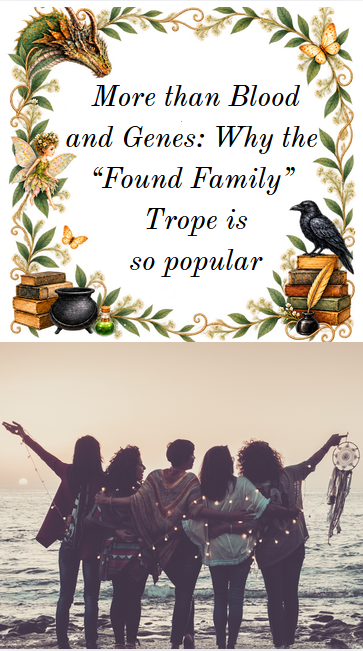
Why "Found Family" is one of the most popular Tropes
A group of people (or creatures) who aren't related by blood, but who come together through shared experience, shared hardship, or plain coincidence—and end up meaning more to each other than their families of origin. That's the found family trope, one of the most beloved constellations in fantasy and science fiction. Guardians of the Galaxy. The Crows from Leigh Bardugo's Six of Crows. A motley crew of misfits giving each other exactly what their birth families never could.
It's tempting to think of this as a modern invention. It isn't. Long before Marvel or YA fantasy got hold of it, L. Frank Baum's The Wizard of Oz (1900) told essentially the same story. Dorothy sets off alone and— one at a time—picks up companions along the road: a Scarecrow convinced he has no brain, a Tin Man convinced he has no heart, a Lion convinced he has no courage. Each of them believes they're fundamentally lacking something. And yet, over the course of the journey, each one proves—through cleverness, through loyalty, through sheer nerve—that they had exactly what they thought they lacked all along. They just needed the others to see it. More than a century before Guardians of the Galaxy, the blueprint was already there.
So why does this constellation keep resonating, across genres and centuries? I think it comes down to something quite fundamental: you don't get to choose your birth family. You're born into it, along with whatever expectations, disappointments, or
adaptive difficulties come attached. Found family, by contrast, is family as choice rather than fate. That's exactly what makes it so appealing to so many readers—especially those who've learned firsthand that blood alone doesn't guarantee a sense of belonging. The trope essentially says: you're allowed to choose your own people. And once you have, they count just as much, maybe more. Underneath it, there's the deep, universal need for connection: we're wired for company, whether biological or not, and stories that show a group of outsiders building that connection speak directly to that need. And because these bonds form gradually, through shared hardship, we don’t just see the mutual trust—we experience how it’s being developed.
At its core, that’s also the story I’m telling: several characters, each marginalized by their own environment—in part because of traits they can’t control. Along the way, they gradually find each other. No one plans this group; it simply comes together for a variety of reasons, one encounter after another. Taken together, the very things that made them all misfits ultimately become the skills needed for their shared mission. Much like Dorothy's companions, who don't set out together either, but join one at a time. And much like them, what starts as coincidence becomes something closer to family.