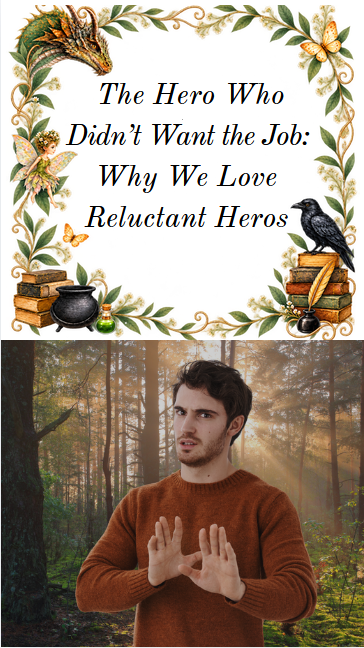
Why We Like Involuntary Heros So Much
When I started plotting my story, one thing was clear to me: My protagonist wouldn’t be the type to volunteer. No sword in hand, no “I’m going to save the world”-look in his eyes—more like someone who’d rather hide in the library. Though in his case, this isn’t just due to his thirst for knowledge and his love of books: his world simply doesn’t offer him any way to influence events, so he puts his energy into what he can control. It is precisely this involuntary passivity—which shifts when circumstances force him to act—that makes this character so interesting to me.
The “reluctant hero” is one of the most enduring figures in the narrative tradition: someone who doesn’t seek the role of hero but is thrust into it. He doubts himself and his capabilities, and more often than not, it is precisely this hesitation that allows us to empathize with him and gives the story its emotional depth. The classic structure behind this is often familiar, even if we can’t quite put a name to it: the call to adventure, refusal, a triggering event that leaves no choice, the reluctant decision—and a journey of growth that can only be recognized as a hero’s journey in retrospect. Bilbo wants tea and his bookshelf, not dragons. Frodo wants the Ring just as little as Aragorn wants to become king. He carries it only because no one else can. Initially, Luke Skywalker doesn’t want anything to do with the Rebellion. Even Odysseus, in one of the oldest stories of this kind, feigns madness to escape war, and later wants only one thing: to go home.
Yet this structure is significantly older than Homer. In the Old Testament’s stories of calling, the same pattern appears in nearly identical sequence. Moses responds to his calling with an objection familiar from the movies—only two thousand years earlier: “Send someone else.” Gideon considers himself too insignificant to save anyone. Jeremiah thinks he’s still too young to speak. And then there’s Jonah… Each time, doubt is followed by a sign or encouragement, and finally the decision to do it anyway. The reluctant hero is therefore not a modern narrative device, nor even an ancient Greek one—it belongs to the oldest patterns we know for depicting the actions of people who, for various reasons, overcome their fears and rise above themselves.
But why do we actually like these characters so much? I believe it is precisely because of this hesitation. Very few of us get up in the morning wanting to save the world, lead a rebellion, or fight against something bigger than ourselves. We hesitate, procrastinate, and think twice—or even three times—about whether we’re really the right person for the job. A hero who does exactly that doesn’t feel like a fantasy figure, but rather like someone who’s just like us. When that character finally takes action—not out of innate courage, but because they have no other choice—it feels earned, not given. When we’ve witnessed that hesitation, it makes the courage that follows all the more believable. We may admire the classic “born” hero, but we’re more likely to recognize ourselves in his hesitant counterpart.
That was exactly the starting point for my “hero”: He didn’t choose his heritage. But when he’s brutally torn from his former life and faced with a choice for the first time, he accepts the challenge.